From Sneaker Drops to the JSE: The Business of Hype

What do a limited-edition pair of Jordans and a billion-rand speculative listing have in common?
At first glance, very little. One belongs to sneaker culture and streetwear. The other belongs to the trading floors of the Johannesburg Stock Exchange (JSE) and the financial markets.
But look closer and the connection becomes clear: both operate on the same forces - hype, timing, and scarcity.
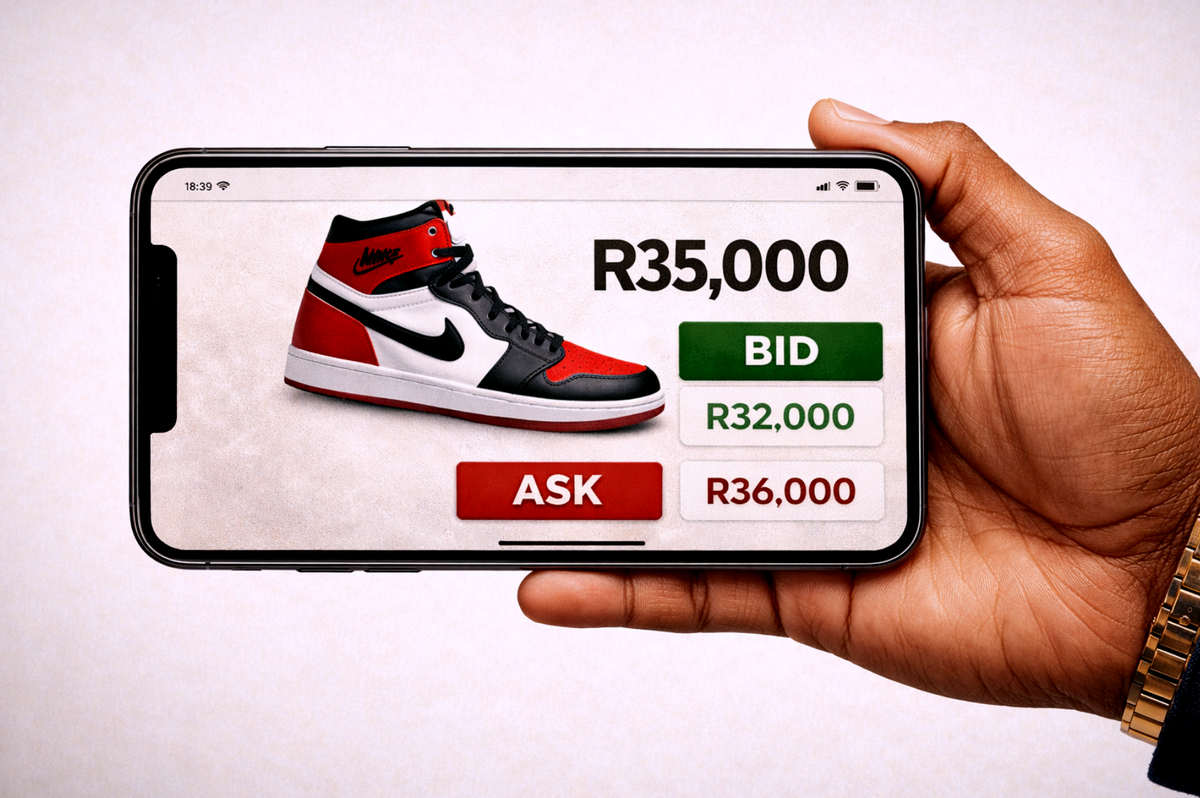
Over the past decade, the sneaker industry has quietly transformed from a fashion category into a speculative marketplace. A pair of sneakers retailing for R3,500 can easily resell for R35,000 or more. The jump in price is not driven by the cost of materials or manufacturing. Instead, it comes from limited supply, engineered demand, and the psychology of the drop.
Scarcity is deliberate. Anticipation is carefully cultivated. And value emerges from attention.
This dynamic is not unique to sneakers. It also mirrors how speculation works in financial markets.
Across global markets - from New York to Johannesburg - investors often buy into narratives as much as they buy into fundamentals. Companies raise capital not only on the basis of current performance but on the promise of future potential. Investors place bets on growth stories, technological breakthroughs, or cultural shifts that may or may not fully materialise.
In many ways, sneaker culture anticipated this psychology long before finance openly embraced it.
Drop culture turned ordinary consumer goods into assets. Brands release limited quantities at precise moments, knowing that scarcity will trigger demand. A shoe that sells out in seconds immediately appears on resale platforms such as StockX, GOAT, and Grailed, where prices fluctuate according to demand just like a stock.
Each release begins to resemble a market event.
The mechanics are familiar to anyone who understands trading: buy early, hold during the hype, and sell once the market peaks.
What began as street culture has now evolved into an informal exchange economy. Sneakers move through secondary markets where price discovery happens in real time. Collectors track resale values, monitor release calendars, and treat rare pairs as portfolio pieces rather than simply footwear.
In Africa, this shift is becoming increasingly visible.
Cities such as Johannesburg, Lagos, Nairobi, and Cape Town are seeing a growing community of sneaker collectors and resellers. Social media, digital payment platforms, and global logistics networks have made it possible for African consumers to participate directly in the same cultural and resale ecosystems that drive markets in Europe, Asia, and the United States.
The sneaker marketplace is now global.
But the psychology behind it remains deeply human.
People are not simply buying shoes. They are buying into a story - a narrative about culture, status, identity, or belonging.
In that sense, sneakers function much like speculative assets. Their value is often determined less by their utility and more by their symbolic power.
Streetwear culture has therefore done something remarkable: it has transformed attention into liquidity.
A successful sneaker drop mobilises thousands of buyers instantly. Resale markets appear within minutes. Prices surge and settle as supply meets demand. It is a miniature version of a financial market playing out in real time.
At the same time, financial markets have borrowed from culture. Storytelling, branding, and narrative now play a central role in how companies attract investment and attention.
The result is a new type of economy where culture and capital mirror one another.
In this environment, scarcity becomes a financial strategy. Attention becomes a measurable asset. And product drops begin to resemble public offerings.
The sneaker world may have started with leather, rubber, and logos, but it has evolved into something far larger: a marketplace where emotion, speculation, and storytelling shape value.
Whether someone is trading equities on the JSE or flipping a limited sneaker online, they are participating in the same broader system - the market of attention.
Understanding that system may be one of the most important insights for the future of the footwear industry.
Because in the modern marketplace, the most powerful product is not always the one with the best materials or technology.
Sometimes, it is simply the one with the best story.